Forget the Channel: lionelwindsor.net
-

It’s Time to Speak Out
A sermon about the importance of speaking the gospel of Christ, based on Romans 1:1-6.
-

Andrew Heard: “Women and ‘teaching’ : What is Paul prohibiting in 1 Timothy 2:12?”
Andrew Heard is the Senior Minister of EV Church and has written a paper engaging with an ongoing discussion over the meaning of the verb “teach” in 1 Timothy 2:12.
-
Speaking Up: The Privilege of Prayer
A sermon preached at St Augustine’s Anglican Church Neutral Bay
-
Claire S. Smith, Pauline Communities As ‘Scholastic Communities’: A Study of the Vocabulary of ‘Teaching’ in 1 Corinthians, 1 and 2 Timothy, and Titus
Themelios has just published an excellent summary review of Claire Smith’s detailed (500 page+!) monograph on the vocabulary of “teaching” in 1 Corinthians and the Pastoral Epistles. The review was written by Andrew Clarke in Aberdeen. I highly recommend it for anyone who would like to familiarise themselves quickly with the key findings of Smith’s scholarly work. Smith’s monograph undergirds many…
-
The identity of Paul’s interlocutor in Romans 2:17-29
In my book, I argue that Paul in Romans 2:17-29 is addressing a Jewish synagogue teacher
-
“Are we worse off?” or “Are we better off?”? (Romans 3:9)
In my book, I argue that “Are we [Jews] worse off?” is a plausible translation of the question προεχόμεθα; in Romans 3:9, given the context in which it appears.
-
Jewish identity and the Law of Moses (Romans 2:17-20)
In my book, I argue that Romans 2:17-20 is a compact description of the close relationship between Jewish identity and the synagogue-based communal engagement with the Law of Moses.
-
The structure of Romans 2:17-29
In my book, I argue that the Romans 2:17-29 consists of three sections. This cuts across the traditional division of the passage into two sections.
-
Preachers and Leaders 4: Preaching and congregational leadership today
Now, as then, preaching should be understood as the public component of the speech of a congregational leader to a congregation under his care, by which he ensures that the congregation learns, obeys and holds on to the truth of God’s word. A congregational leader leads his congregation by preaching; conversely, preaching is the key…
-
Romans 2:17 is referring to a “publicly recognized Jew”
In my book, I argue that Paul’s interlocutor in Romans 2:17-29 is a paradigmatic mainstream Jew.
-
Preachers and Leaders 3: Preaching as congregational leadership: a venerable history
The regular sermon, according to key figures from church history including Chrysostom, Augustine, Calvin, Cranmer and Perkins, is the key means by which shepherd-leaders fulfil their responsibility to ensure that the truth of God’s word is guarded, learned and obeyed among their congregations.
-
The social context of Romans 2:17–29: the Jewish synagogue
In my book, I argue that Romans 2:17-29 is set in the Jewish synagogue.
-
Preachers and Leaders 2: The speech of shepherd-leaders in the New Testament
In a number of places across the New Testament, we see a certain pattern of congregational leadership. Christian congregations often include certain people who are described as carrying a weighty responsibility. This responsible leadership role is based on and derived from the word of the apostles, which in turn is grounded in the Old Testament…
-
Romans 2:17-29 is an argument about Jewish Identity
In my book, I argue at length that Romans 2:17-29 is not primarily an argument about salvation, but rather an argument about Jewish identity and vocation.
-
Preachers and Leaders 1: A separation of preaching and leadership?
Among the many important issues and questions that have been raised during recent debates about women and preaching, one that has received perhaps too little attention is this: What exactly is this thing we call a ‘sermon’ or ‘preaching’? Preaching is the public component of the speech of a congregational shepherd-leader to the congregation under…
-
Preachers and Leaders Preface: The publication history of Hearing Her Voice
This post is an online preface to my essay “Preachers and Leaders”, defending the essay and the book in which it appears against a particular charge relating to the publication history of one of the books which it interacts (*Hearing Her Voice* by John Dickson)
-
The “obedience of faith” in its prophetic context (Romans 1:5)
In my book, I argue that Paul’s phrase “the obedience of faith” in Romans 1:5 can be better understood when read in the context of prophetic (Isaianic) motifs.
-
Paul did not proselytise
In my book, I argue that the apostle Paul’s mission should not be described as “proselytism”.
-
Tenacious Love (1 Peter 1:22-2:3)
A tenacious love – born from an enduring message – arousing a healthy craving
-
Paul’s priestly ministry in Romans 15: a fulfilment of Isaiah 60-61
In my book, I argue that Paul’s description of his “priestly” ministry in Romans 15:14-33 is drawn from Isaiah 60-61, which describes Israel’s eschatological priestly role toward the nations. This reinforces Paul’s depiction of his apostolic ministry as an eschatological Jew-Gentile dynamic.
-
A privilege to serve (1 Peter 1:10-16)
A sermon preached at St Augustine’s Anglican Church, Neutral Bay. Outline: The victim mentality Rejoice in your privilege (vv. 10-12) Our historical privilege Our cosmic privilege Run from ignorance to grace (vv. 13-14) Be holy in all you do (vv. 15-16) Holiness is our divine vocation Holiness is for every aspect of life Holiness involves…
-
Paul describes his ministry in terms of Isaiah’s “Servant of the Lord” (Romans 1:1)
In my book, I argue that when Paul uses the term δοῦλος in Romans 1:1, he is drawing on the scriptural figure of the “Servant of the Lord” found in Isaiah 40 –55, especially (but not exclusively) in Isa 49:1–7.
-
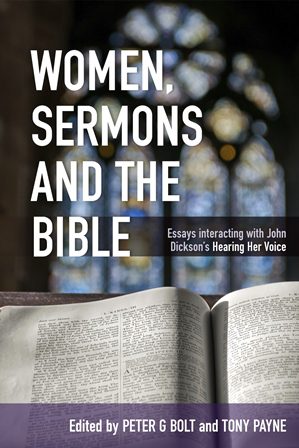
Book – Women, sermons and the Bible: Essays interacting with John Dickson’s “Hearing Her Voice”
In late December 2012, John Dickson published an eBook in which he presented a novel proposal concerning the Greek term normally translated “teach” (didaskō) in 1 Timothy 2:12. I have had an opportunity to contribute to a book in which various authors interact in depth with Dickson’s proposal, and find it wanting on multiple fronts.
-
What was Paul’s former “zeal”? Divine jealous passion for Israel’s purity
In my book, I argue that the ζῆλ* word-group in Paul and in Acts should normally be understood as a “divine jealous passion” for the purity of the people of Israel and their Law.
-
Why I’m going to the NEXUS conference on 26 May
NEXUS, on Monday 26 May in Annandale, Sydney, is deliberately designed to maximise opportunities to discuss the ideas that are raised and to grow together in our desire to share Christ with the world.

















Got any book recommendations?