Listen to the talk here or read the transcript below
Preacher: Lionel Windsor
Church: St Nics Anglican Church, Coogee
Date: 13 September 2026
Bible text: based on NIV 1984
Jesus, the government, and the world around us
It’s clear that tensions are very high at the moment in our world, our community, over all sorts of issues and over what our governments are or aren’t doing about them. There is fear, there’s anger. Obviously an issue constantly before us in the news is antisemitism. We live not far away, in Newtown.
I remember less than three years ago now, after the 7 October attacks, I remember our own local state member in a public meeting using those awful antisemitic catch cries reminiscent of ’30s Germany about Jews having their tentacles in our businesses. I remember walking onto the campus of Sydney University, with students openly protesting hatred of Jews. I remember our own local synagogue being firebombed.
And I remember the fear of our own church’s neighbours just next door here with the extra security. And of course we have had those horrible, tragic Bondi shootings so recently. Christians are often afraid themselves.
I’ve just been in Victoria a few months ago speaking with Christians there. The state government has shown that they want to stop Christians from speaking. They introduced laws during the pandemic prohibiting what’s called conversion practices. Some claimed they were just trying to outlaw the fringe dubious practice of gay conversion therapy.
But when you actually read the legislation, you actually see it’s much more than that. There’s a wide range of interpersonal interactions. The core examples they gave were religious practices like prayer and conversations with a community leader. So technically, if you’re a Christian leader in Victoria, and you provide help and encouragement to a person to affirm them in their own Christian conviction to remain celibate in their circumstances, you’re breaking the law and could be subject to fines or prison. The laws outlawing religious freedom have been endorsed by Amnesty International, which was originally instituted to stop governments persecuting people due to their religious views.
We’ve had similar laws introduced in New South Wales. Technically there’s more checks and balances in New South Wales, but it actually depends on the regulators and how they enforce it.
So how should Christians think about the world around us? How should we respond to these things, to government authorities, especially governments that aren’t necessarily friendly to biblical teaching? Because it’s understandable, isn’t it, to be afraid, to be angry.
What should our attitude be? And what does this have to do with God? Well, the Bible definitely does speak to these questions. Our passage today, 1 Timothy chapter 2 verses 1 to 7, is very helpful for us. This is a passage about how we as believers in Christ are to live as human beings in this human world. And how we are to relate to the humans around us, including especially the human authorities around us.
So this passage doesn’t tell us exactly what to do in any given situation politically. It doesn’t tell us who to vote for, but it does tell us some core attitudes we’re to have. And these attitudes aren’t just a matter of convenience, they’re a matter of the nature of God, who Jesus is, And Jesus’ death on the cross. So the key instruction in verse one is prayer. Prayer is about trust in God. That’s what prayer is. It’s the core expression of faith. You want to say what prayer is, it’s faith articulated. It’s when you trust in God, what’s the first thing you do?
You pray. But the passage isn’t just give us a bare command, pray. No, it tells us why we should pray. And it tells us about the God who we are praying to. And in this passage we see God’s heart for all humanity. If you see the passages there in your outline, we’ll see it there as well. The idea of all humanity is everywhere in this passage. You can see it there.
Verse 1, everyone, verse 4, all men, verse 6, all men and more. All men being all men and women, everybody. This passage teaches us about God and humanity, so it teaches us how to live as humans among humans and human authorities.
God rules over all humanity (1 Timothy 2:1–2)
The first thing we need to know is that God rules over all humanity.
I urge, then, first of all, that requests, prayers, intercession and thanksgiving be made for everyone— for kings and all those in authority, that we may live peaceful and quiet lives in all godliness and holiness.
1 Timothy 2:1–2
If you’ve been here the last few weeks, you’ll see Paul’s actually in many ways just continuing what he said in chapter one as he wrote to Timothy, his ministry colleague in Ephesus, ancient Ephesus, an ancient what’s now modern day Turkey. Timothy’s job is to deal with false teachers. The false teachers were all about endless arguments. But not just that on the ground, living before God rightly.
So they had a spirituality which was all up there, a spirituality about myths. They didn’t care about the goodness of God’s creation. And against these false teachers, Paul wants Timothy to make sure that people in church pray. What kind of prayer? Well, not just prayers for individual concerns inside the church, They’re good things to pray for. Not just prayers for the church, not just prayers for leaders of the church, but here Paul urges prayer for everyone.
And when he says everyone, he’s talking about everyone in our world, that the people living their regular lives day by day under human authorities. And Paul’s especially talking here about governments, people who rule and people who help them to rule. So pray for the government, he says. And you might say, well, that’s all very well if you live under a friendly government or a Christian government. I mean, surely, you know, The Bible was more applicable in past centuries, wasn’t it, because it was easier to pray for the king and the government because the king was happy to call himself a Christian, and so was the queen.
That’s different today, isn’t it? Surely this passage isn’t so relevant to times when the government is antagonistic. You know, that’s not what this passage is about. Surely we should do more than pray or not just pray for them. Firstly, let me just remind you exactly what kind of government Paul’s talking about as he writes to Timothy. He’s writing to Timothy in Ephesus, as I mentioned, in the west of modern-day Turkey. At that time, it was under Roman rule and it had a government that was not so friendly at all to Christians or to Jewish people generally. It was a city with a lot of idols.
And it was a city with authorities that demanded obedience. Bron, Ellie and I had a chance to visit Ephesus last year. Here’s a picture of the main government area. It’s just the ruins of Ephesus now.
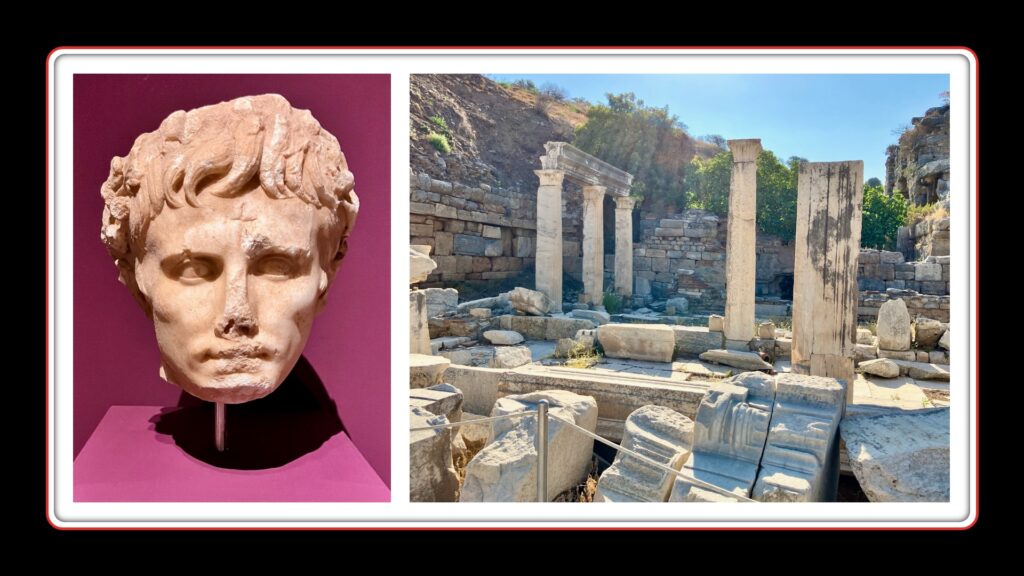
Here’s the main government area. And where is it? It’s right at the top of the city, right at the top. It had statues of rulers to remind everyone who is in charge.
And who’s in charge? The remains of a statue of Emperor Augustus who’d ruled up to AD 14. At that point, Nero, you know the one who’d burned to death Christians in the streets, that Nero. The authorities under the Emperor literally put themselves above everyone.
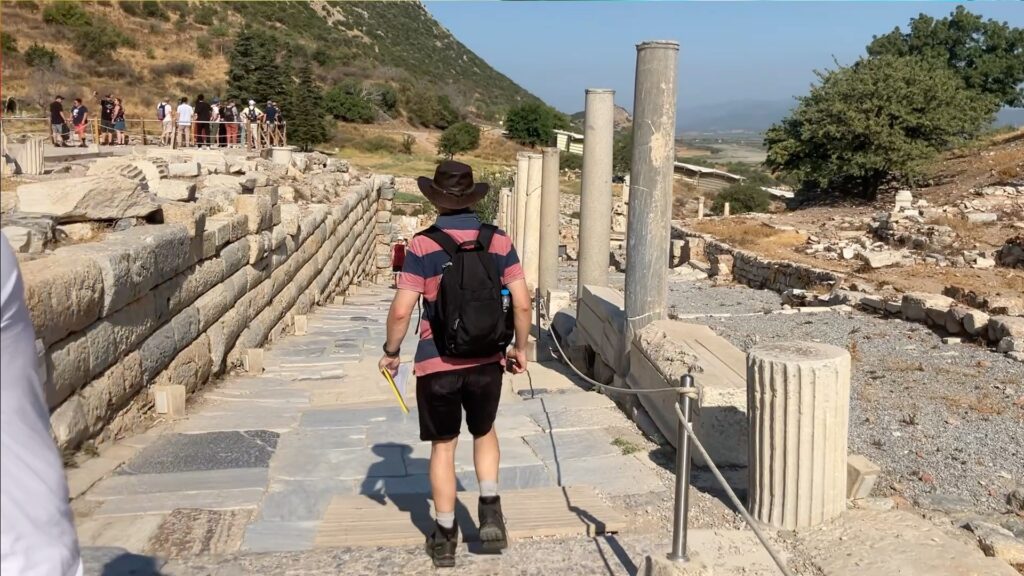
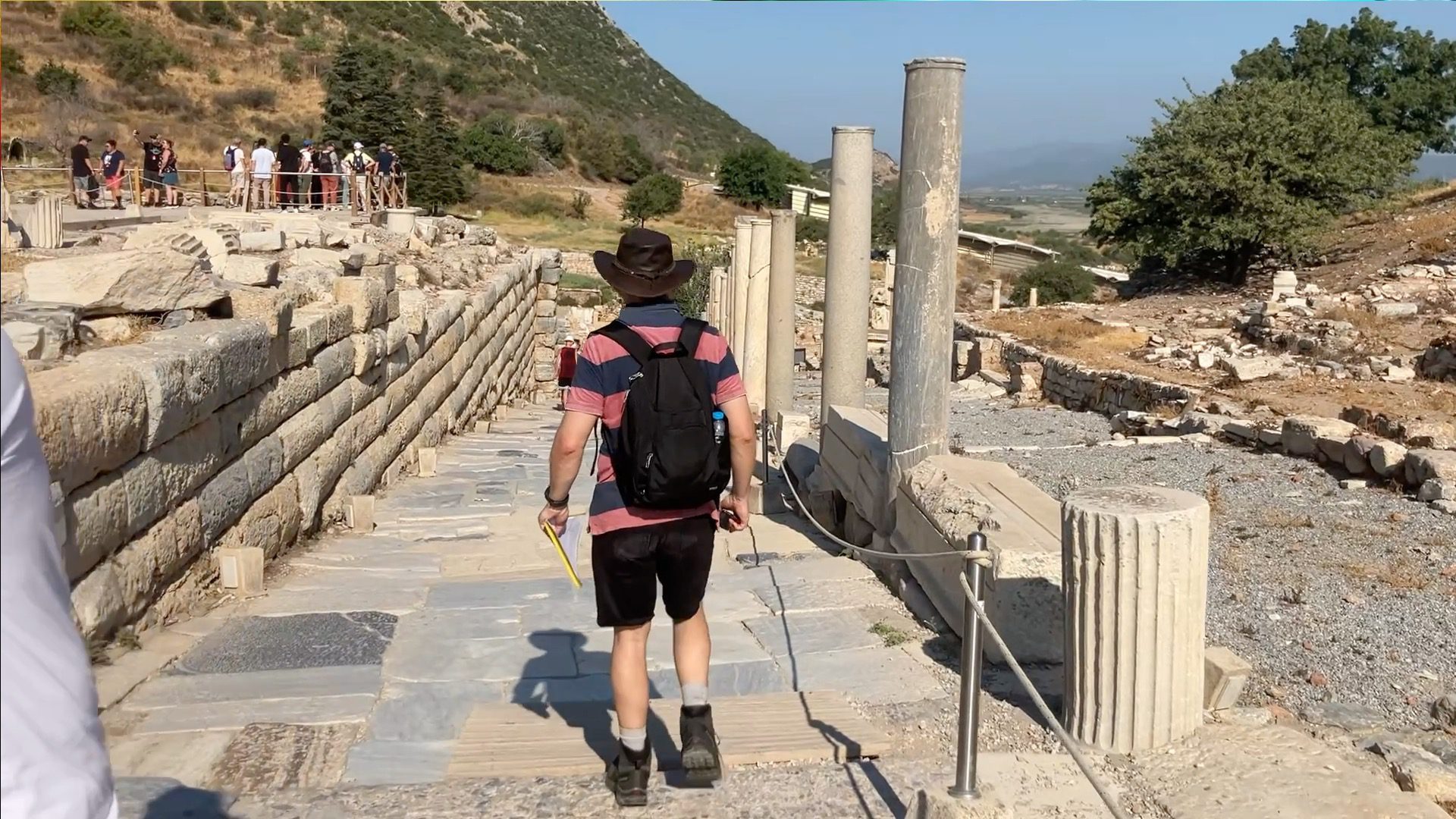
So, okay, here’s a video. It’s a one-minute video, but I’ve just got 10 seconds of it because it’s just a video of me, Bron took it of me, walking down from the government area to everybody else, the rest of the city. That was before my hip replacement, so I’m limping. There I am. What’s the point? Okay, so the point is they were above everyone.
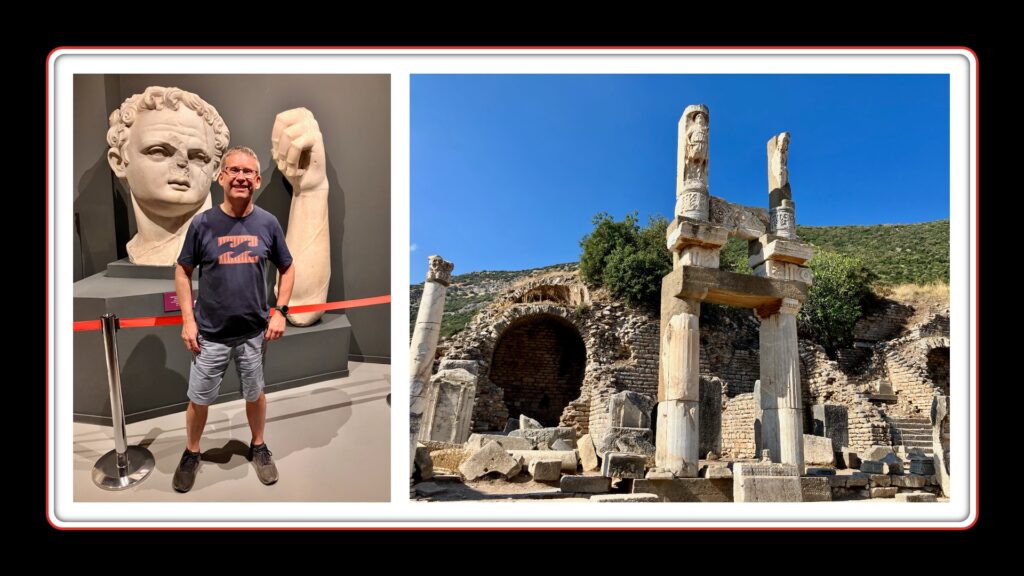
Soon after this, the emperor Domitian arose to rule with an iron fist. He demanded worship from people. But the emperor worship was still gaining ground even when Paul was writing. So when Paul says, pray for kings and those in authority, he’s not just talking about nice ones. In the ancient Roman Empire, most of the authorities were not particularly friendly at all to Christians. Sometimes they were downright hostile. They were often harsh, corrupt, incompetent.
And the same is true today, isn’t it? I mean, in many parts of our world, sometimes it’s even hard to work out what the legitimate authority is. Even for us in Australia, where actually our governments tend to give us a whole lot of freedom, generally do an okay job, there’s definitely hostility and certainly not perfect. So what’s our response to authority? One response could be is to treat the government as the enemy, full stop.
And treat Jesus like an alternative regime to say, okay, no government authority, just Jesus, like Jesus is a rival government that we live under instead of the government. But that’s actually not what Paul’s saying, is he? He’s saying, pray to the Lord of the government. Why should we pray for all humanity and especially the human authorities? Because God is the authority above all of those authorities. Paul’s already said in the previous chapter, he’s described God as the King of the ages, immortal, invisible, the only God to whom be honor and glory forever.
So you see God, Jesus, is not a rival authority to the human authorities. He’s not someone that you worship instead of those authorities at the top. He is at the top. God is at the top. He’s above those authorities. So when we pray for authorities, what we’re actually doing is we are acknowledging that God is the ultimate authority above them.
And that should be profoundly comforting for us. Our God, the Father of the Lord Jesus, He’s not just an alternative or an enemy to human authorities, He’s the Lord over them. He’s even the Lord over the ones that aren’t so great. That word in verse 1, you’ve got in your outline, intercession. The word is actually another way of translating it is petition. You’ve heard of the word petition sometimes used in terms of prayer.
Well, actually, petitions. We also know about petitions when it comes to government, don’t we? You get a bunch of signatures to make an appeal to a politician, to a ruler, to get them to do something for you, to say this is something that really concerns us so much that we want you to do something about it. Paul’s saying our petition, firstly, is to be sent to God. When you feel frustrated at our authorities, at our government, what we naturally want to do first, the first thing we want to do, make our voice heard.
Send a letter, get a petition happening, a petition to the local council, a petition to the Premier, a petition to the Prime Minister. That might be a helpful thing to do. But actually, there’s something far more important to do first, isn’t there? Don’t just bother with the Prime Minister. Send a petition to the King of Kings. To the Lord of the Prime Minister. Because God hears us.
And he hears us and can do something about it far more than they can. They’re the most important petitions we ever bring, those petitions to God, asking him to intervene and to direct the minds and hearts of our governments. Those prayers for our world, they are powerful. Because he is the Lord and he cares. That’s what it means to have faith. To have faith is to trust in God.
The first thing when you have faith is not fear or anger. You might feel those things, but faith. And how do you express faith primarily by prayer? By asking the God we trust. And by the way, that’s why praying for our world, especially including the authorities, is so central in the Anglican prayer book. It’s right there. That in turn is soaked in Scripture.
And that’s why we do that often in our weekly prayers. Why should we be praying for these authorities? Well, verse two, so that we can live as rightly ordered human beings, live peaceful and quiet lives. Living a peaceful and quiet life, he’s not talking about some kind of farm stay or a retirement plan or something like that. What he means is these are words of civil peace, these are words of being able to submit To authorities, rightly ordering our lives, living as humans among other humans.
Now, that doesn’t mean that we never criticise the government. It doesn’t mean we slavishly obey the government always, absolutely, especially when they tell us to disobey directly God’s word. But it does mean that as Christians, our heart’s desire and our goal is not anarchy. Our goal Well, actually, our goal isn’t sort of religious freedom either fully. If we think religious freedom is the super ideal goal or an inalienable human right beyond all else, no.
Our prayer and goal ultimately is to have a good ordered word, being able to do right, being able to live peaceably for the sake of the good of others, which includes asking God for the ability to gather in prayer, to gather to hear God’s word, So you see, this passage doesn’t tell us exactly what to do, but it tells us something far more important. It tells us what to desire and what to pray for.
And it tells us what our normal and regular attitude should be. Obedience to the government normally isn’t the enemy of Christian freedom. Normally it’s the means for Christian freedom. And Christian freedom, it’s not just the absolute freedom to do whatever we want at any time. What it is, is the freedom specifically to live for God, to love our neighbour. And of course, part of that today is taking part in the political process when we can, being informed, making our voice heard, voting.
But most fundamentally, the key way that we take part in the political process is to pray. To pray. To pray to the one who knows and cares And to remember that God is Lord of all, because we are humans under God, living among humans who are also under God, whether they recognise it or not.
God wants all humanity to be saved (1 Timothy 2:3–4)
But actually there’s another, even deeper reason for this prayer for all humanity, and it’s this, that God wants all humanity to be saved.
This is good, and pleases God our Saviour, who wants all men to be saved and to come to a knowledge of the truth.
1 Timothy 2:3–4
God sees our prayers as inherently good, fitting, beautiful prayers indeed for our government to live peaceful and quiet lives. Why? Because God’s Saviour. God in Jesus is my Saviour and your Saviour. Which is a wonderful and beautiful thing. We looked at that last week, didn’t we? Christ Jesus came to the world to save sinners. But he’s not just our Saviour. God’s will for salvation is bigger than you and me. It’s far bigger. He doesn’t just want you to be saved. He doesn’t just want me to be saved. He doesn’t just want the people sitting in this building to be saved. He wants everyone to be saved.
The authorities like the mission and others, they declared they were the saviours. God’s the saviour. Now just to be clear, Paul’s not necessarily saying here that every individual human being will be rescued from God’s wrath. That’s not actually his point here. His point is about the wide scope of salvation. His point is that God’s salvation isn’t just something that’s just for you
And for me, God’s salvation is relevant for all humanity beyond you and me. Christ Jesus came into the world to save sinners, and that’s relevant to everyone because every human being in our world is a sinner, and every human being who trusts in Jesus will be saved. That means that all human beings need to come to a knowledge of the truth to heed that Gospel message that Christ Jesus came into the world to save sinners.
So who does God want to be saved? God wants those many idolatrous people that we read about in our Old Testament reading to be saved and to come to a knowledge of the truth. He wants Jewish people to be saved. He wants people walking down our street right now to be saved. He wants the people right now at Bondi Beach in Coogee Beach to be saved. He wants Victorians to be saved. He wants people living in Newtown to be saved. He wants people who are born in Australia to be saved. He wants people who’ve immigrated to Australia to be saved.
He wants people in western Sydney to be saved and in the eastern suburbs to be saved. He wants the people in your family to be saved. So there’s a danger for us as we gather in church that we could narrow our focus to just ourselves and to our group. To care about those we see, to care maybe about our insider knowledge.
In fact, it was the false teachers in Paul’s day who were into all that sort of insider knowledge. But that’s not what the gospel is like. The gospel is not some kind of insider knowledge that we can just, you know, keep to ourselves. It’s a truth for everyone. God wants all people to come to a knowledge of the truth. And that helps to put even our longing for religious freedom in perspective as well, because freedom It’s not an ultimate ideal. It’s not the thing to pursue at all costs. Freedom isn’t an end in itself.
It’s a good thing, but religious freedom is for a greater purpose, to enable us to live for God, to love our neighbor. And we want freedom not for ourselves, but freedom for us and others to have opportunities to speak about this saving message to others, which is how people are saved. So that’s there to keep our prayers big. To pray for individuals, for nations, to pray for God’s mercy for people to be safe and for people to be saved. To pray for the gospel to go out, for all people to come to a knowledge of the truth. Praying that way is really good for us.
It helps us to avoid being inward-looking. But it’s not just good for us. It’s good, as it says, to be in pleasing to God, our Saviour. That’s God’s desire for the world.
There is one human mediator for all humanity (1 Timothy 2:5–6a)
In fact, there’s another even deeper reason for this prayer for all humanity. It’s something to do directly with who Jesus is and what Jesus came to do.
For there is one God and one mediator between God and men, the man Christ Jesus, who gave himself as a ransom for all men
1 Timothy 2:5–6a
Paul’s referring here to Deuteronomy chapter 6, which we read last week. There is only one God. Deuteronomy chapter 6 verse 5. “The Lord our God, the Lord is one.” So let’s spell out the logic a little bit here. If there’s one God, that means that the one God is the God of everyone. That is, this God is not just the God of you, the God of me, the God of the Christians. The people sitting in the church. He’s the god of everyone, whether they acknowledge it or not.
And because of that, there is only one mediator between that one god and human beings. There are lots of mediators in Ephesus in the ancient world.
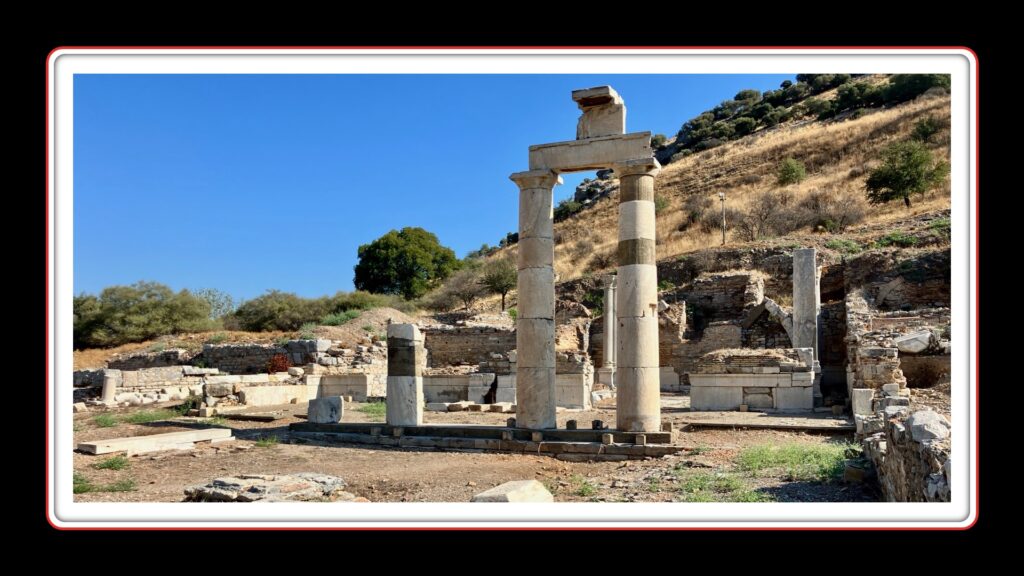
Here’s the ruins of the Prytaneion, this important city hall, again, up in the government area. And it was the home of the sacred fire of Hestia as this Idea of an eternal unquenchable flame that dedicated to the Greek goddess of behalf. It was the stability of the community. You keep the fire going and then everything will be fine. They thought if those priestesses in Ephesus kept the home fires burning, they could stop all the bad things happening.
They could keep the gods from being angry. The city would survive and then the gods would listen to them, make life better for everyone. Paul’s saying no. Those priests can’t mediate. With the one God. It doesn’t matter how much they keep the fire going. This isn’t how you make God happy with you. This isn’t how you save the world. So what it is today, maybe it seems increasingly that many of our governments think that the great mediation, the great way we can keep everybody safe constantly is regulation. You know, add more and more rules, rules regulate everything, and then everything will be great and happy.
It doesn’t work. There’s one mediator and that’s Jesus Christ. Why? Because Jesus Christ is God the Son and also because he is truly human. Why does that matter? Because Jesus did what needed to happen to actually solve our issues and bring us into relationship with God. What did he do? He died on the cross for our sins. He was our substitute. He died in our place For us because that’s the issue, human sin. Left to our own devices, we would just be helpless sinners facing God’s wrath forever.
But Jesus was truly human and he truly died in our place as a ransom, as a price paid. And that matters so much. If you remember last week, Christ Jesus came into the world to save sinners. By his death on the cross. That’s what we need. And nobody else has done this. Nobody else can do this. Because what you need is someone who is perfect God and perfect humanity, and that is only Jesus.
And that matters for you and for me. It’s also vitally important for us as we consider everybody around us, our fellow human beings. When you see your fellow human being walking down the street or on the beach or at the shops or online or in the government, what’s the first thing you see? An enemy? A threat? A stranger? An outsider?
Well, if you believe the gospel of Jesus Christ, the first thing to remember is that your fellow human being is Human, like you and me. And when you become a Christian you don’t give up being a member of the human race. And your fellow human is very much like you in that key way, in that they’re a sinner in need of salvation, like you and me.
And the humanity that Christ took on, it’s not just your humanity or my humanity, it’s the humanity that’s common to all and that should lead us to pray for all people who need this Saviour, that they would come to this one mediator, Jesus Christ. And of course, that’s an exclusive claim in the sense that it’s exclusive because we’re saying that this particular man, Jesus Christ, is indeed the only way to God and there’s no other way to God.
But the very fact that it’s exclusive should actually make us inclusive. Never inward focused. Why? Because it’s always ever about God’s grace for us human beings who are unworthy. And we are, as preachers in the past have said, we’re just like beggars showing other beggars where to find the bread. Grace to the unworthy, that’s for you, that’s for me, that’s for everyone to come to him.
So we must never turn Jesus into an excuse to narrow our focus or to isolate ourselves. We’re all in this together. And that should lead us to pray, pray for all humanity and to long for the salvation of all humanity.
The saving message of the gospel is for all humanity (1 Timothy 2:6b–7)
And that’s why the saving message of the gospel is, as Paul says, for all humanity.
—the testimony given in its proper time. And for this purpose I was appointed a herald and an apostle—I am telling the truth, I am not lying—and a teacher of the true faith to the Gentiles.
1 Timothy 2:6b–7
And when he says to the Gentiles, he means the nations, he means everybody in the world. God wants all humans to be saved, to come to a knowledge of the truth. And Paul was the teacher of that true faith to the nations. That’s the reason this gospel message is so powerful, because it doesn’t only save individuals, it transforms families and it does transform societies and governments and it has done down through the ages, hasn’t it?
As we’ve seen the gospel taken seriously by nations, by governments, we’ve seen the change it makes, never perfectly but truly. So we should care about all nations, all humans, that they hear this gospel and pray for humanity and our human authorities. And seek as we can to be the answer to our own prayers, and especially through sharing that gospel word.
Now, I know that there’s more to say about this question. The passage doesn’t tell us everything that’s relevant to those questions of freedom and authority, and as I said, it doesn’t tell us exactly what to do. But what we learn here is something very important, fundamental things about God’s heart for humanity. God rules over all humans, that God wills for all humans to be saved, that there’s one human mediator for all humans, Jesus Christ, which gives us a reason to pray for our governments, to live as human beings, to long for the salvation of all humanity, to proclaim that saving gospel message to all humanity.
We’re going to be praying today for some of those things. How about I begin us, leading us in prayer for those things.
Father, we thank you that as we come to you, you are the God of all, and your Son Jesus Christ is the mediator for all. We pray that you would open and lift our hearts to see your heart for all humanity and your rule over all humanity. We pray right now that you would rule and bring peace. We pray for our neighbours just down the road, in this suburb, in this city, in this nation and in our world, that you would bring salvation and peace so that we can proclaim that message. We pray this in Jesus’ name. Amen.Closing prayer